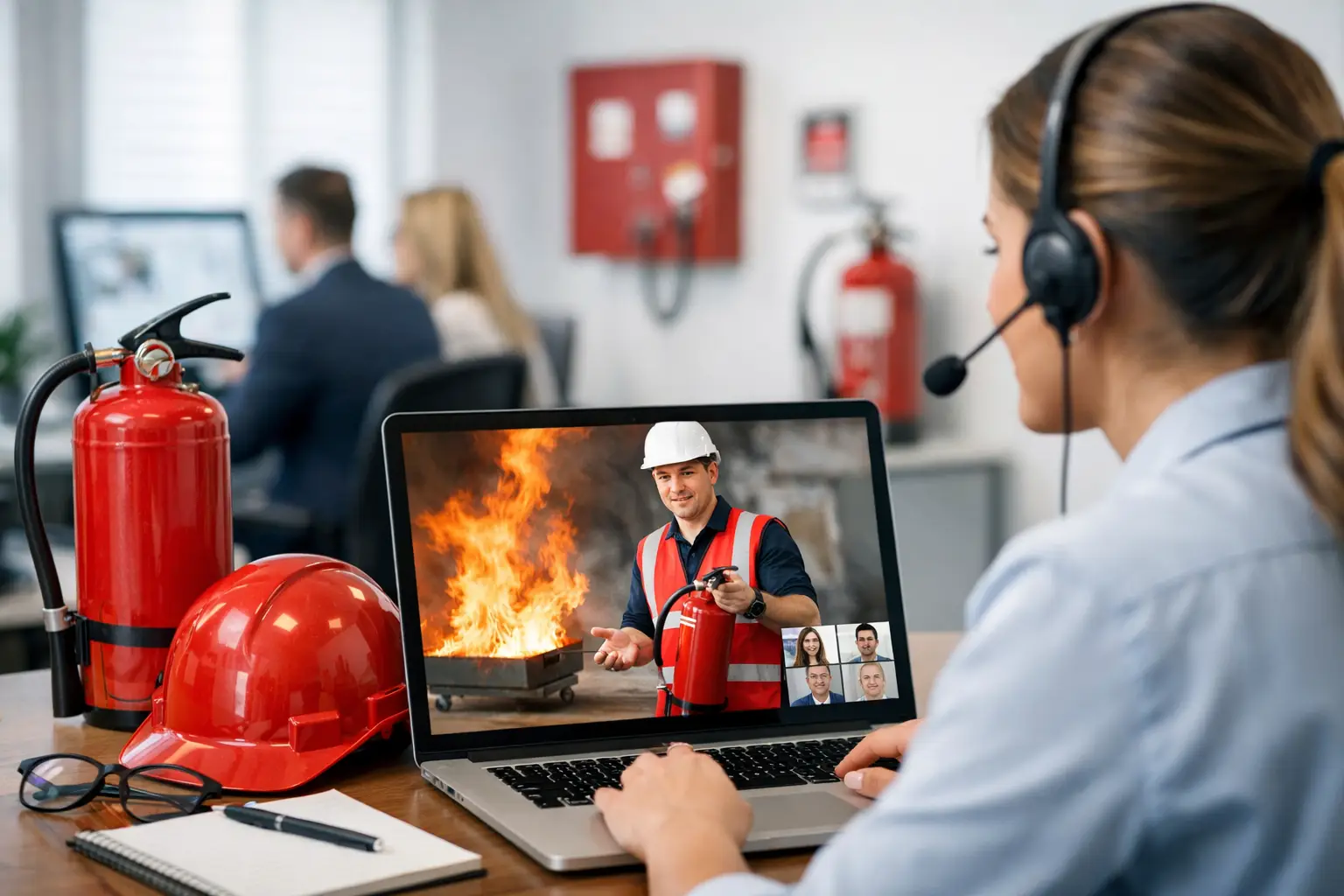
A fire alarm during a busy working day does not leave time to search for instructions or decide who is responsible for checking a meeting room. Office fire warden training online gives nominated staff a consistent grounding in the actions, responsibilities and awareness needed to support a safe evacuation.
For facilities managers, estates teams and business owners, the value is not simply that training can be completed remotely. It is the ability to make fire safety instruction available across departments, shifts and locations while retaining a clear record of completion. Used properly, online learning supports the wider fire safety arrangements already in place at the premises – it does not replace them.
What a fire warden is expected to do
A fire warden, sometimes called a fire marshal, has a practical role in helping occupants respond safely to a fire alarm or emergency. Their duties should be defined by the building’s fire risk assessment, emergency plan, layout, occupancy and management arrangements.
In a typical office, a warden may direct people towards the nearest safe exit, check allocated areas if it is safe to do so, report relevant information to the person managing the evacuation, and help identify people who may need assistance. They should understand the alarm arrangements, escape routes, assembly point and how to avoid re-entering the building until authorised.
The role is not to fight a fire, investigate an alarm in unsafe conditions or put themselves at risk. A well-trained warden understands the limits of their responsibility. Life safety comes first, and any area check must only be undertaken where conditions allow and the premises procedure requires it.
Why online training suits office environments
Office-based organisations often face a straightforward operational problem: getting the right number of people trained without taking whole teams away from their work at the same time. This can be particularly relevant for multi-floor offices, hybrid workforces, serviced workplaces and organisations with several sites across the North East.
Online training allows employees to complete learning at a suitable time, with content delivered consistently to each learner. It can also make refresher training easier to manage when staff change roles, new starters join, or fire warden coverage needs strengthening after an internal review.
The main benefit is control. A responsible person or facilities manager can maintain training records, identify gaps in coverage and demonstrate that nominated personnel have received appropriate instruction. This supports audit readiness and gives managers a clearer basis for planning drills and reviewing emergency procedures.
However, online learning has a trade-off. It cannot show whether a warden knows the actual route from a particular office suite, understands a local refuge point or can communicate effectively during a live evacuation. Those details must be covered on site.
What effective office fire warden training online should cover
A suitable course should explain the purpose of the fire warden role before moving into practical actions. Learners need to understand how fires develop, how fire and smoke spread through a building, and why closed fire doors, protected routes and clear escape paths matter.
It should also cover the emergency response sequence: raising the alarm where necessary, responding to an alarm, encouraging prompt evacuation, directing occupants safely, and reporting concerns at the assembly point. Training should make clear that wardens should not delay their own escape to complete checks where there is any danger.
For commercial premises, good instruction also addresses the everyday issues that undermine fire safety. These include wedged-open fire doors, items stored in corridors, obstructed final exits, damaged signage, poor housekeeping and changes to room use. Wardens are often well placed to spot these conditions, but they need a clear route for reporting them so that remedial action is tracked and completed.
Training should not be generic to the point of being detached from the workplace. An office above a retail unit, a university administration block, a school office or a hotel back-office area will have different evacuation challenges. The learning provides the foundation; the building-specific fire procedure turns it into a usable response.
The link between training and UK fire safety duties
Under the Regulatory Reform (Fire Safety) Order 2005 in England and Wales, the responsible person must take general fire precautions to ensure, so far as is reasonably practicable, the safety of relevant persons. This includes establishing appropriate procedures for serious and imminent danger and providing employees with suitable fire safety instruction.
There is no single legal formula that states an exact number of fire wardens for every office. The right provision depends on the fire risk assessment. Factors can include floor area, the number of occupants, shift patterns, visitors, lone workers, the presence of disabled persons, travel distances and the complexity of the building.
A small, single-storey office may require a different level of coverage from a multi-occupancy building in Newcastle or Leeds with several tenants and shared escape routes. Where trained wardens are absent due to annual leave, sickness or shift changes, the emergency plan can quickly become weaker than intended. Deputies and sufficient trained cover are therefore as important as the initial appointment.
Turning training into a workable site procedure
Online learning is most effective when it sits within a controlled fire safety system. Following completion, each warden should receive a local briefing that confirms their allocated area, the nearest exits, alternative routes, alarm call points, fire doors, assembly arrangements and escalation process.
The responsible person should also ensure wardens know where the building’s fire action notices and emergency information are located. If personal emergency evacuation plans are in place, the relevant arrangements must be communicated sensitively to the people responsible for supporting them. Wardens should understand their role without being given responsibilities they are not equipped or authorised to carry out.
Evacuation drills provide the practical test. They reveal issues that e-learning cannot: occupants who ignore alarms, congested stairways, unclear responsibilities at the assembly point, visitors who have not been briefed, or doors and routes that are not functioning as expected. Findings should be recorded, assigned and closed out, rather than treated as a one-off exercise.
For larger sites, it is useful to distinguish between the role of floor wardens, fire marshals, security teams, reception staff and the person coordinating the evacuation. Confusion is common when everyone assumes someone else is checking a particular area. A simple, documented allocation of duties reduces that risk.
Common gaps that put office arrangements under pressure
The most frequent weakness is appointing a warden by job title rather than by availability and suitability. A senior employee may be a strong choice, but they may also spend much of the week off site or be regularly in meetings away from their allocated area. Coverage needs to reflect how the office actually operates.
Another issue is relying on a completion certificate as evidence that the system works. Certificates are useful records, but they do not confirm that escape routes are clear, compartmentation is intact, fire doors close properly or the alarm and emergency lighting are maintained. These controls require inspection, testing and, where necessary, specialist remedial works.
Businesses should also review training after material changes. Refurbishment, new partitions, altered layouts, changes in occupancy, a move to hybrid working or revised access arrangements can all affect evacuation planning. A fire risk assessment review may identify that warden numbers, zones or procedures need to change.
Choosing an approach that supports compliance
When selecting office fire warden training online, look beyond convenience. The course should be relevant to UK workplace duties, clearly explain safe limits of action and provide a reliable record of participation. It should be straightforward enough for staff to complete confidently, while still giving managers assurance that essential subjects have been addressed.
It is equally important to plan what happens after the course. Local familiarisation, current fire risk assessment findings, written emergency procedures and regular drills are what turn learning into a credible life-safety arrangement. Where inspections identify defects in fire doors, compartmentation, signage or escape routes, these should be assessed and resolved through a documented corrective process.
For organisations managing offices alongside schools, warehouses, hotels or university buildings, role-specific training and site-specific procedures may be needed rather than a single blanket approach. The best arrangement is the one that reflects the people, risks and layout of each premises.
A trained fire warden should never be left to carry the whole burden of fire safety. Give them clear duties, adequate cover, practical site knowledge and a well-maintained building around them. That is how online training becomes part of a safer, more defensible compliance programme.