A fire-resistance upgrade can look straightforward on a drawing, then become far more complicated once ceiling voids, services, occupied areas and existing finishes are considered. The decision between intumescent paint versus boarding is not simply about appearance or programme. It is about achieving the required fire performance with a tested system that suits the building, its structure and the way it operates.
For commercial property owners, facilities managers and project teams, the right approach begins with the fire strategy and verified site information. Both options can provide effective protection when correctly specified and installed. Neither should be selected as a generic substitute for the other.
What intumescent paint and boarding are designed to do
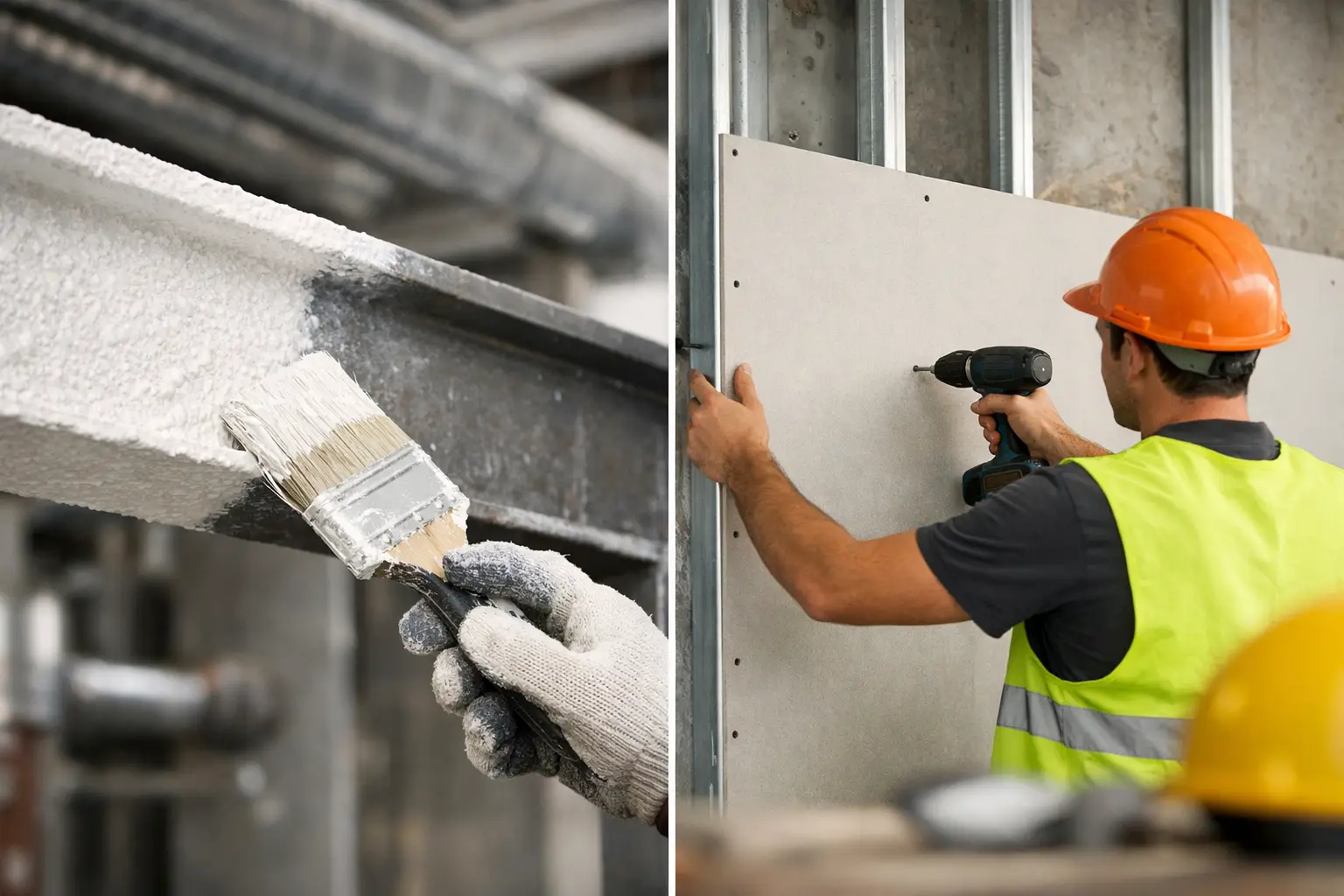
Intumescent paint, more accurately called an intumescent coating, is commonly used to protect structural steel. In a fire, the coating reacts to heat and expands into an insulating char. This slows the rate at which steel heats up, helping it retain its load-bearing capacity for the required fire-resistance period.
The system is normally made up of a compatible primer, the intumescent base coat applied to a calculated dry film thickness, and a suitable topcoat where environmental protection or a particular finish is required. Its performance depends on the steel section, the number of exposed sides, the critical steel temperature, the specified duration of fire resistance and the manufacturer-tested specification.
Boarding is an encasement system, often formed from fire-resisting boards fixed around steelwork, columns, beams or other construction elements. The board protects the substrate by creating an insulating barrier between it and fire exposure. It can also be used to form fire-resisting walls, ceilings and enclosures, depending on the tested system and application.
The key point is that a board system is not just a board type. Fixings, joints, joint treatment, support framing, board thickness, service penetrations and edge details all contribute to the stated fire performance.
Intumescent paint versus boarding: the practical differences
The most visible difference is the finish. Intumescent coatings can preserve the profile of exposed steel, making them a frequent choice in reception areas, atriums, retail spaces, schools and university buildings where the architectural design calls for a cleaner, more open appearance. Boarding creates a boxed finish around the protected element, which may be entirely acceptable in plant rooms, warehouses, service areas and back-of-house spaces.
However, aesthetics should not be the deciding factor. A coating application needs the correct surface preparation and controlled installation. Steel must be accessible, clean and suitably primed, and the applied thickness must be checked throughout the works. Inadequate preparation, incompatible existing coatings or uneven film thickness can compromise the system.
Boarding can be more forgiving where steelwork is irregular or where a practical enclosure is needed around complex areas. It may also allow for straightforward visual confirmation that an element has been protected. Yet boards require sufficient space around the member, accurate detailing at connections and careful treatment where services pass through the encasement. Damaged corners, unsealed joints and unapproved alterations can reduce performance.
Space, access and programme constraints
Restricted access often affects the decision. Intumescent coatings are applied in multiple coats and may require drying time between applications. Temperature, humidity and ventilation can influence application conditions, particularly in partially open buildings or cold-weather projects. The contractor must be able to reach every required face of the steel and carry out wet and dry film thickness checks.
Boarding involves cutting, handling and fixing materials on site. It can be a practical solution where wet trades are undesirable or where work must be sequenced around other building activities. Conversely, it may be difficult to install neatly in congested ceiling voids or around densely routed mechanical and electrical services.
In occupied hotels, schools, care settings and offices, containment of dust, noise and access routes must also be planned. The method that looks quickest in isolation is not necessarily the method that causes the least disruption to occupants and operations.
Durability and future maintenance
Neither approach is fit-and-forget. Intumescent coatings should be protected from conditions beyond their stated environmental suitability. A coating intended for a controlled internal area may not be appropriate for external exposure, persistent moisture, impact-prone zones or aggressive industrial environments without the correct compatible topcoat.
Coated steel also needs a clear inspection regime. Damage from later trades, service installations, impact or water ingress must be identified and repaired in accordance with the approved system. A patch made with an unspecified product or applied at the wrong thickness cannot simply be assumed to reinstate the original rating.
Boarding is vulnerable to impact, water damage and unauthorised penetrations. It is common for later works to leave openings around cables, pipework or ductwork. Where this occurs, the board enclosure and associated fire stopping need to be assessed as one detail, not treated as separate maintenance issues.
The specification must be based on evidence
A fire-resistance period such as 30, 60, 90 or 120 minutes is not a label that can be applied to a material alone. It is the performance of a specific construction or protection system under defined conditions.
For structural steel, the required protection thickness for an intumescent coating is calculated from information including the section factor, steel profile, orientation, exposure and critical temperature. Applying a single coating thickness across a project without checking these variables can create serious gaps in performance.
With boarding, the design must follow the tested or assessed detail for the relevant steel member and required duration. This includes the board product, thickness, layer arrangement, fixing centres, jointing method and any supporting components. Replacing one element with a similar-looking alternative may invalidate the evidence supporting the installation.
A competent survey is particularly valuable in existing buildings. Original fire-protection records may be incomplete, historic alterations may have concealed the structure, and previous remedial work may not match the current fire strategy. Before work begins, the existing condition, substrate and intended fire-resistance line should be established and documented.
When intumescent paint is often the stronger choice
Intumescent coating is often appropriate when exposed steel is part of the intended design, when retaining headroom matters, or when boxing-in the steel would interfere with the layout of a commercial space. It can be well suited to visible structural frames in offices, education settings, hotel communal areas and refurbished industrial buildings.
It is also useful where the reduced profile of the coating avoids clashes with adjacent fittings. That said, close proximity to other elements can make it harder to prepare and apply the coating correctly. The apparent space saving is only a benefit if all faces requiring protection remain accessible and verifiable.
When boarding may be the better solution
Boarding may be preferable where the steel does not need to remain visible, where a boxed enclosure will protect it from minor knocks, or where the overall construction requires a fire-resisting casing or compartment detail. It is frequently practical in warehouses, factories, plant spaces and service-dense parts of larger commercial premises.
It may also provide a sensible route where the steel substrate has coatings that are difficult to prepare for an intumescent system, subject to confirmation through survey and manufacturer guidance. Boarding does not remove the need for good preparation and detailing, but it can avoid some of the application controls associated with reactive coatings.
For projects across Newcastle, Sunderland, Durham and the wider North East, early coordination is especially valuable where older buildings meet modern refurbishment requirements. Surveys often reveal hidden constraints that materially affect the chosen protection method.
Inspection, records and handover matter as much as installation
The final appearance of protected steel is not sufficient evidence of compliance. A quality-controlled installation should be supported by records that show what was installed, where it was installed and how it was checked.
For intumescent paint, this typically includes substrate condition, primer compatibility, batch information, dry film thickness readings, topcoat details and photographs. For boarding, records should capture the board specification, fixing arrangement, joint treatment, relevant penetrations and photographs before areas become concealed.
These records support the responsible person, building owner and facilities team during audits, future refurbishment and routine inspection. They also make it easier to target maintenance where changes to the building could affect passive fire protection.
Make the decision before site assumptions take over
Choosing between intumescent paint and boarding should follow a clear sequence: confirm the required fire performance, survey the existing structure, review the fire strategy, select an evidence-backed system and plan installation around the building’s operational constraints. This approach reduces the risk of late changes, incomplete protection and remedial work after handover.
Where there is uncertainty, a specialist passive fire protection survey can turn an assumption into a documented scope of work. That gives project teams a sounder basis for protecting occupants, supporting compliance and keeping the building ready for the next inspection.