A fire inspection that is booked only when an audit is approaching is already late. For a facilities or estates team, the question of how to schedule fire inspections is not simply about finding an available date. It is about creating a planned, evidenced programme that identifies defects early, protects occupants and gives the responsible person a clear record of compliance.
For commercial premises, hotels, schools, factories, warehouses and universities, a well-managed inspection schedule brings order to a complicated set of fire safety duties. It also makes remedial work more manageable. Instead of discovering a large number of non-conformances at once, building managers can prioritise risks and act before small defects become serious compliance failures.
Start with your legal duties and fire risk assessment
The starting point is the building’s current fire risk assessment. Under the Regulatory Reform (Fire Safety) Order 2005, the responsible person must take general fire precautions and ensure that fire safety measures are maintained in an efficient state, in efficient working order and in good repair.
Your fire risk assessment should identify the measures that need inspection, testing or maintenance. These may include fire doors, compartment walls and service penetrations, fire alarm systems, emergency lighting, fire extinguishers, evacuation signage, smoke control systems and fire safety records. It should also identify areas of greater risk, such as sleeping accommodation, plant rooms, commercial kitchens, laboratories, workshops or premises with complex escape routes.
Do not assume that one annual visit covers every requirement. Different systems have different inspection and maintenance intervals. The correct frequency depends on the equipment, manufacturer guidance, relevant British Standards, the building’s use, the number and vulnerability of occupants, and the findings of the fire risk assessment.
Build a complete fire safety asset register
Before dates can be scheduled properly, establish exactly what you are responsible for. An asset register is the practical foundation of a reliable programme. It should record the location, type, identifier, condition, service history and next due date for each relevant fire safety asset.
For passive fire protection, this means more than counting fire doors. Record door sets, fire-resisting walls, fire-stopping around services, cavity barriers, dampers and other compartmentation measures where applicable. Accurate location information is particularly valuable in large or altered buildings, where drawings may no longer reflect the layout on site.
A detailed register prevents common problems: duplicated inspections, missed assets, unclear ownership between landlord and tenant, and reports that cannot be converted into practical remedial works. It also allows inspection findings to be tracked from defect identification through to completion and verification.
Separate routine checks from specialist inspections
Routine checks and specialist inspections serve different purposes. Daily or weekly observations by trained site staff can identify obvious issues, such as obstructed escape routes, wedged-open fire doors, damaged signage or an alarm panel showing a fault. These checks should be recorded, but they are not a substitute for a competent technical inspection.
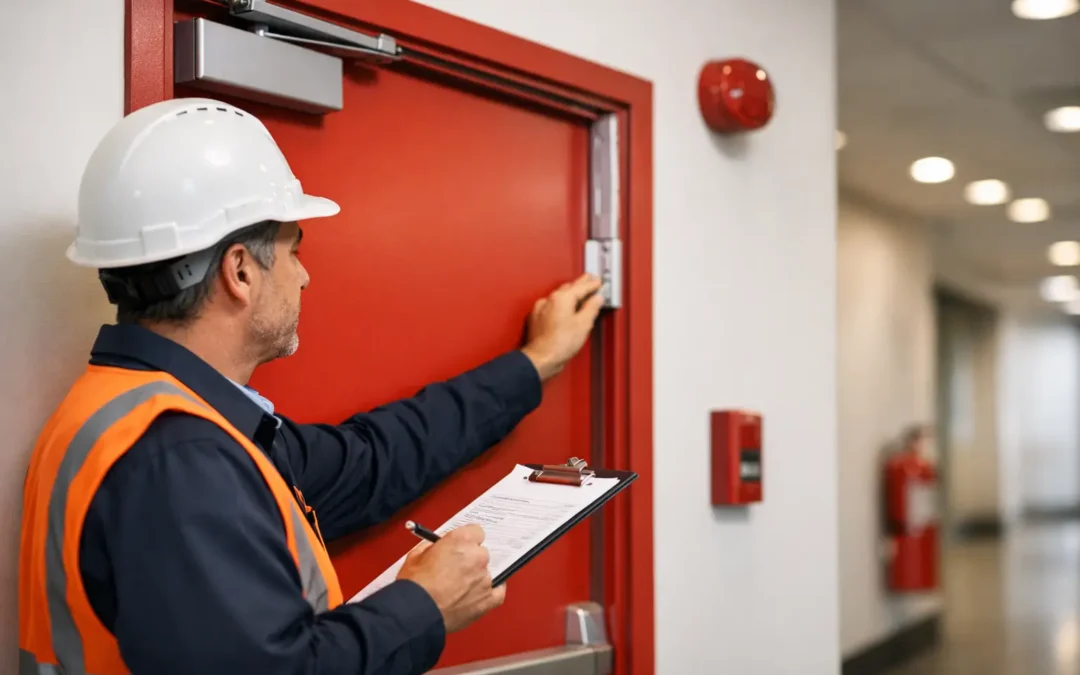
Specialist inspections assess whether systems and passive measures continue to perform as intended. A fire door inspection, for example, may consider the door leaf, frame, seals, hinges, closers, glazing, gaps, signage and evidence of damage or unauthorised alteration. A compartmentation survey may examine whether penetrations and concealed voids have been adequately protected.
Both levels belong in the schedule. Routine checks allow site teams to act quickly. Competent inspections provide the detailed evidence needed to assess compliance, prioritise remedial work and support the responsible person’s decision-making.
Set inspection frequencies that reflect the building
A sensible programme combines statutory duties, recognised guidance and the real conditions within the premises. Fire alarm systems commonly require regular user testing and planned inspection and servicing. Emergency lighting needs routine functional checks and periodic full-duration testing. Portable fire extinguishers require planned maintenance. Fire doors and passive fire protection require inspection at intervals appropriate to their risk, use and condition.
High-traffic doors, doors on key escape routes and doors within sleeping-risk premises may need more frequent attention than rarely used doors in a low-risk office area. Similarly, a warehouse that undergoes frequent fit-outs, a university estate with changing room use, or a hotel with constant guest turnover should not rely on a static schedule created years ago.
Review the programme whenever there is a material change. Refurbishment, new service installations, a change of tenant, altered occupancy, fire damage, repeated defects or a revised fire risk assessment can all justify bringing inspections forward. Passive fire protection is particularly vulnerable after building works, because new cables, pipes and ductwork can compromise compartment lines if penetrations are not correctly sealed.
Plan inspections around operational reality
An effective schedule protects safety without creating unnecessary disruption. Speak to building users before booking intrusive surveys, alarm servicing or inspections that require access to occupied rooms, risers, ceilings or plant areas. In a school, this may mean planning visits outside teaching periods. In a hotel or student accommodation block, access arrangements and occupant communication need careful management. In a factory or warehouse, inspections may need to account for shift patterns, production areas and permit-to-work controls.
Provide the inspection provider with current plans, known access restrictions, previous reports and details of recent works. This improves the quality of the visit and reduces the chance that assets are missed. For multi-site estates, grouping inspections by location can also help maintain consistency, provided the programme still meets the required frequencies.
For organisations across Newcastle, Sunderland, Durham, Tynemouth, Leeds and the wider North East, it is often helpful to maintain one central compliance calendar while allowing local site managers to manage access and day-to-day checks. The responsible person still needs oversight of the whole programme, even where tasks are delegated.
Choose a competent inspection provider
Competence matters because fire safety reports must lead to defensible action. Select a provider with relevant technical knowledge, appropriate certifications where applicable, experience of your building type and the ability to explain findings clearly. A report that merely states that an item has failed is of limited value if it does not identify its location, the nature of the defect, the associated risk and the recommended corrective action.
For passive fire protection, the provider should understand how individual elements work together. A compliant-looking fire door may still be compromised by poor installation, unsuitable hardware or defects in the surrounding wall. Likewise, fire-stopping cannot be judged reliably by appearance alone where service penetrations, substrates and tested system details are involved.
It is also worth considering what happens after the inspection. Where defects are found, the most efficient route is often a provider that can support surveying, reporting, remedial specification and practical works. This reduces handovers, keeps recommendations aligned with the original findings and provides a clearer audit trail.
Make reporting and remedial action part of the schedule
Booking the inspection is only the first stage. Each visit should produce a report that is detailed enough to support action. At a minimum, it should identify the premises or area inspected, the date, scope, findings, photographic evidence where useful, risk-based priorities, recommendations and any limitations on access or inspection.
Assign every action to a named person, set a target completion date and record the final outcome. Urgent defects should be escalated immediately rather than waiting for the next compliance meeting. Examples may include a damaged fire door on a protected route, missing fire-stopping around a major penetration, or a fault affecting a life safety system.
Keep completed reports, service certificates, routine test records, training records, remedial evidence and updated fire risk assessments together in a controlled record system. During an audit, investigation or enforcement visit, clear evidence of inspection, decision-making and completed corrective action is as important as the inspection itself.
Review the programme, not just the dates
A calendar can appear compliant while repeatedly producing the same overdue actions. Review the programme at least annually to identify recurring defects, inaccessible areas, missed appointments and assets approaching end of life. This is where inspection data becomes useful management information rather than a collection of certificates.
If fire doors are consistently damaged in one corridor, for example, the answer may involve changes to traffic management, staff awareness or door protection, not just repeated repairs. If maintenance staff regularly penetrate fire-resisting walls during minor works, the solution may include tighter permit controls and targeted fire safety training.
A good inspection schedule gives your team control: clear responsibilities, realistic access arrangements, competent assessment and evidence that defects have been closed properly. That is the standard worth planning for – not simply a date in the diary, but a safer building that is ready to stand up to scrutiny.